Ivory Tower
On dignified decline and casino lifelines.
I love my beach town on the Jersey Shore – Brigantine, a small island connected by just one bridge to mainland Jersey. We’ve called it our Bridge to Happiness™ since 2011, when my family bought a duplex unit on 43rd street. In reality, it’s the Atlantic City–Brigantine Connector, meaning our one route to Brig snakes through AC’s infamous terrain. As a result, I have developed a vested interest in the success of Atlantic City.
America’s Playground. A former crime den run by Jersey mobsters. The sordid inspiration behind Monopoly. AC gets a bad wrap! But driving through its marshy wetlands and its looped highways or traipsing tipsily along its wooden boardwalk or staring at its sparkling casinos from across the strait has made me a bit of a romantic for this city – perhaps one of the few.
I heard that NYC was finally opening a casino of its own, Resorts World in Queens, set to cut its ribbons next week. Instead of excitement, I felt dread for my Vegas of the East, which until now has enjoyed the privilege of housing the few legal casinos on the East Coast. I knew that casino revenues were a key part of Atlantic City’s economic engine. But what I didn’t know was how Atlantic City came to this moment. This curiosity led me to this week’s reading…
What Happened to Atlantic City? by Lyman Stone
America’s Original Playground is a Parable of Economic Development Gone Wrong
Published by eccentric economist Lyman Stone in 2016, this piece dives into how Atlantic City refused to die. From the 1850s to the 1930s, AC boomed due to railroads. A quick trip from Philadelphia or New York would cost you $1.25 and dump you onto pristine Jersey shores, replete with fresh air, Planter’s peanuts, and salt water taffy.
Post WWII, it seems like three factors – highways, the mob’s burgeoning influence, and American soldiers witnessing much nicer beaches around the country – caused Atlantic City’s decline in earnest.
Stone contends that a city should be allowed to decline with dignity, caring for its existing constituents and strengthening its core cultural assets as its population winnows. But Atlantic City decided to go for a lifeline to maintain its economic status: casino investment, which Stone claims destroyed local flavor and led to AC’s current reputation as a tawdry, gauche destination for those that don’t know better.
Balancing culture and efficiency seems to be the primary issue of the day. How much should the market dictate the outcomes of a place, and how much should planners and developers attempt to manipulate it? For Atlantic City, did renewal mean walking through a one-way door – destroying the old hotels and sand castle culture that could have cushioned its inevitable contraction?
While pondering these questions, imagine my surprise when I received a text from my dad – a patient of his just happens to be a city planner, the SAME planner responsible for the following:
Accomplishments include such signature projects as the 178-acre former municipal landfill (Borgata and Harrah’s Towers) and for a 30-acre, long-vacant 1960s Urban Renewal site (Taj Mahal, Showboat and Revel) [combined to represent in excess of $4 billion worth of commercial and infrastructure investment], implementation of Redevelopment Plan which turned the City’s Northeast Inlet, once its most blighted area, into one of its most attractive residential neighborhoods.
Obviously, I had to get on a call with him, if only to understand the thought process behind AC’s casino-centric urban renewal. Plus, I had never spoken to a capital ‘P’ Planner before. I had written some hardballs for Stuart Wiser, the planner in question, but ended up absorbing a lot of his advice about the field instead. He regaled tales of community input gone wrong, like when he had to fight a Zoning Commissioner’s desire to make Pleasantville’s saltwater marshes into Jersey’s Venice. He emphasized that he’s one of the few planners that actually dislikes masterplans, deriding them as inflexible. This point made me think of the following reading:
Order Without Design: How Markets Shape Cities by Alain Bertaud
“[The] professionals in charge of modifying market outcomes through regulations (planners) know very little about markets, and the professionals who understand markets (urban economists) are seldom involved in the design of regulations aimed at restraining these markets.”
If we’re challenging planning orthodoxy, look no further than Alain Bertaud, a distinguished urbanist who asserts that cities are mainly labor markets. As labor markets, they respond poorly to contrived regulations around planned land use and height limits. Wielding tools of ‘design,’ planners may incentivize visible signs of redevelopment, like Detroit’s People Mover, or Atlantic City’s casinos, but neglect the very real economic realities that drive individual decisions and city performance.
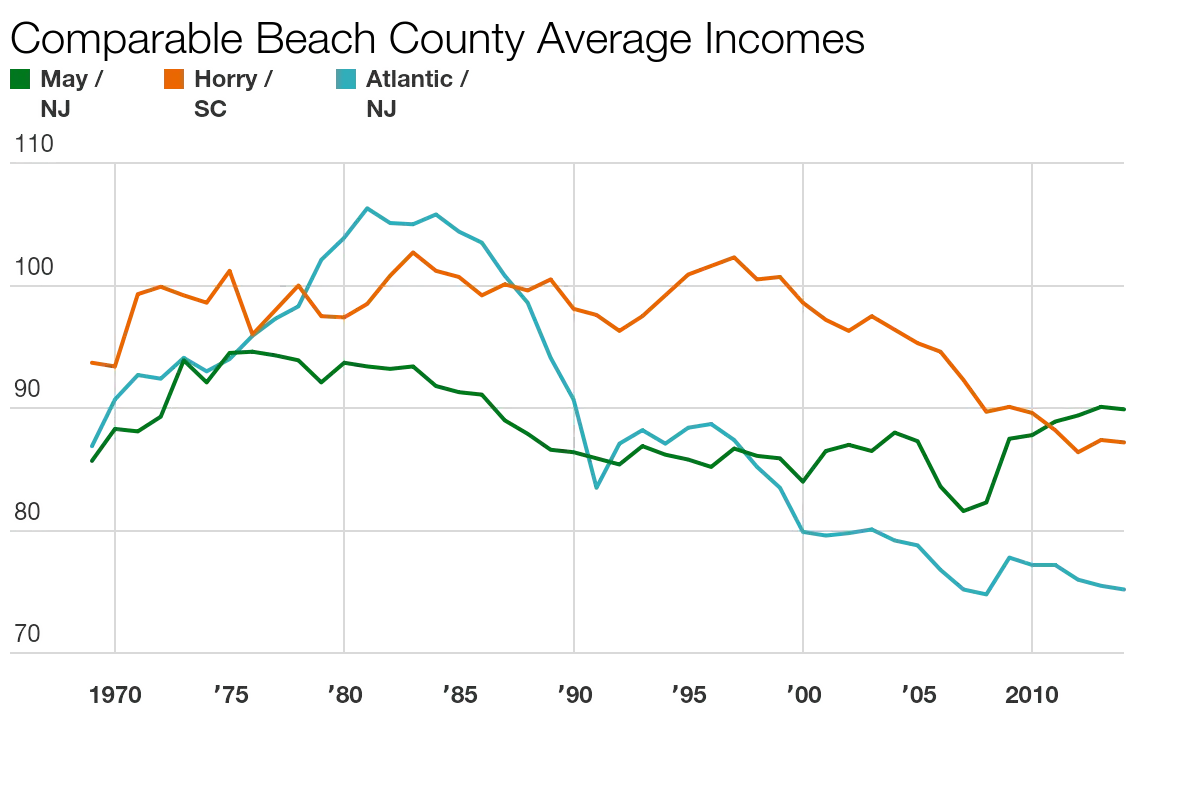
I haven’t made it entirely through Bertaud’s dense material, but Order Without Design resonated as I thought about Atlantic City. Sure, the casinos went up in ‘blighted’ areas and created jobs, but those jobs were unskilled and concentrated in one shaky industry, and the wealth hasn’t remained inside the community. Perhaps the only thing wrong with masterplans is that their time horizon isn’t long enough – Atlantic City thrived for about ten years before its average income bottomed out below Cape May’s.
As I ended the call with Mr. Wiser, he had one piece of advice, gleaned through working with UPenn city planning postgraduates. He urged me to get off the Ivory Tower. Everyone wants to build the next Borgata, but the impactful work is often that of permitting back deck variances and negotiating small ‘p’ politics.